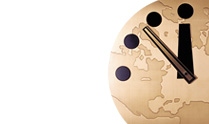
| The Bulletin of the Atomic
Scientists has told the world what time it is since 1947, when its
famous clock appeared on the cover. Since then, the clock has moved forward
and back, reflecting the state of international security.
1947 | Seven minutes
to midnight
The clock first appears on the Bulletin cover
as a symbol of nuclear danger.
1949 | Three minutes
to midnight
The Soviet Union explodes its first atomic bomb.
1953 | Two minutes
to midnight
The United States and the Soviet Union test thermonuclear
devices within nine months of one another.
1960 | Seven minutes
to midnight
The clock moves in response to the growing public
understanding that nuclear weapons made war between the major powers irrational.
International
scientific cooperation and efforts to aid poor nations are cited.
1963 | Twelve minutes
to midnight
The U.S. and Soviet signing of the Partial Test
Ban Treaty “provides the first tangible confirmation of what has been the
Bulletin’s
conviction in recent years—that a new cohesive force has entered the interplay
of forces shaping the fate of mankind.”
1968 | Seven minutes
to midnight
France and China acquire nuclear weapons; wars rage
in the Middle East, the Indian subcontinent, and Vietnam; world military
spending increases while development funds shrink.
1969 | Ten minutes
to midnight
The U.S. Senate ratifies the Nuclear Non-Proliferation
Treaty.
1972 | Twelve minutes
to midnight
The United States and the Soviet Union sign the
first Strategic Arms Limitation Treaty (SALT I) and the Anti-Ballistic
Missile Treaty; progress toward SALT II is anticipated.
1974 | Nine minutes
to midnight
SALT talks reach an impasse; India develops a nuclear
weapon. “We find policy-makers on both sides increasingly ensnared, frustrated,
and neutralized by domestic forces having a vested interest in the amassing
of strategic forces.”
1980 | Seven minutes
to midnight
The deadlock in U.S.-Soviet arms talks continues;
nationalistic wars and terrorist actions increase; the gulf between rich
and poor nations grows wider.
1981 | Four minutes
to midnight
Both superpowers develop more weapons for fighting
a nuclear war. Terrorist actions, repression of human rights, and conflicts
in Afghanistan, Poland, and South Africa add to world tension.
1984 | Three minutes
to midnight
The arms race accelerates. “Arms control negotiations
have been reduced to a species of propaganda. . . . The blunt simplicities
of force threaten to displace any other form of discourse between the superpowers.”
1988 | Six minutes
to midnight
The United States and the Soviet Union sign a treaty
to eliminate intermediate-range nuclear forces (INF); superpower relations
improve; more nations actively oppose nuclear weapons.
1990 | Ten minutes
to midnight
The clock, redesigned in 1989, reflects democratic
movements in Eastern Europe, which shatter the myth of monolithic communism;
the Cold War ends.
1991 | Seventeen minutes
to midnight
The United States and the Soviet Union sign the
long-stalled Strategic Arms Reduction Treaty (START) and announce further
unilateral cuts in tactical and strategic nuclear weapons.
1995 | Fourteen minutes
to midnight
Further arms reductions are stalled while global
military spending continues at Cold War levels. Nuclear “leakage” from
poorly guarded former Soviet facilities is recognized as a growing risk.
1998 | Nine minutes
to midnight
India and Pakistan “go public” with nuclear tests.
The United States and Russia can’t agree on further deep reductions in
their stockpiles.
2002 | Seven minutes
to midnight
Little progress is made on global nuclear disarmament.
The United States rejects a series of arms control treaties and announces
it will withdraw from the Anti-Ballistic Missile Treaty. Terrorists seek
to acquire and use nuclear and biological weapons. |